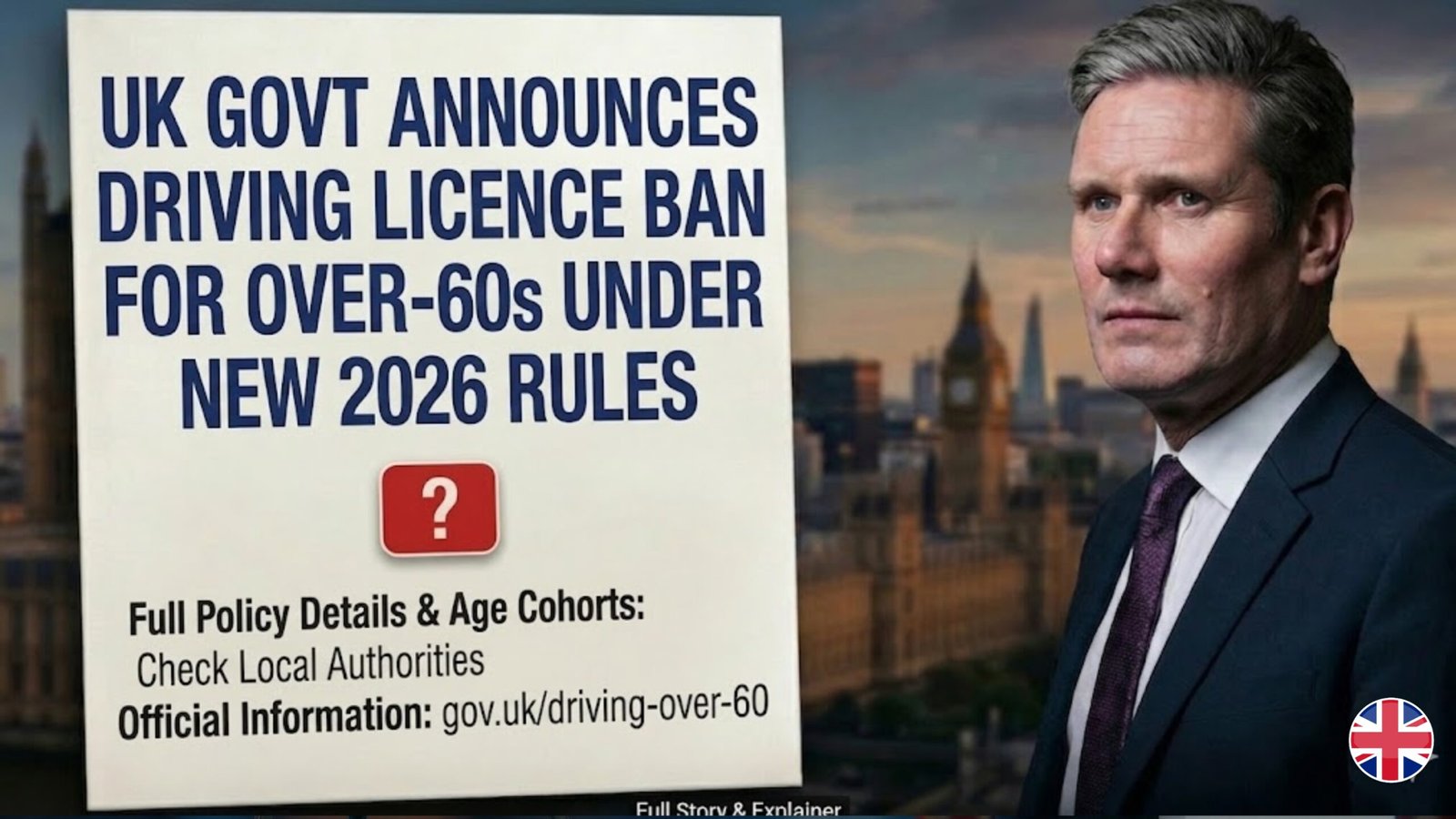
The UK motoring landscape is undergoing a massive transformation as the Department for Transport (DfT) and the DVLA move toward a more stringent safety framework for 2026. For many years, the standard procedure for veteran drivers was relatively straightforward, but new updates have sparked significant conversation—and some concern—among motorists over the age of 60. While the term “ban” is a heavy one, the 2026 regulations introduce “fitness to drive” assessments that could indeed lead to the revocation of licences for those who fail to meet the modernised safety criteria.
Understanding the 2026 Vision Standards
One of the most immediate changes in the 2026 rules involves the enforcement of vision standards. Under the new protocols, the DVLA has been granted enhanced digital access to NHS records, and police now have “real-time” powers to check a driver’s visual acuity at the roadside. If a driver over 60 is stopped and found unable to read a number plate from the statutory 20-metre distance, their licence can be suspended electronically on the spot.
For those renewing their licence in 2026, a “self-declaration” of vision is no longer sufficient. If you have any history of corrective surgery, cataracts, or glaucoma, the DVLA may require a formal vision assessment from an accredited optician before your renewal is processed. This “Act Before Late” approach is designed to catch vision deterioration before it leads to a serious road traffic accident.
Medical Conditions and Mandatory Disclosure
The 2026 updates have expanded the list of medical conditions that must be proactively reported to the DVLA. While many conditions were previously considered minor, the new framework takes a stricter stance on “episodes of confusion,” early-stage cognitive decline, and certain sleep disorders like apnea.
For drivers over 60, the duty to notify has become a legal “hot button.” If a motorist is diagnosed with a reportable condition and continues to drive without informing the DVLA, they face a fine of up to £1,000 and an immediate ban if involved in an accident. The 2026 system is designed to be preventative, encouraging drivers to take “medical pauses” rather than waiting for a permanent revocation of their driving privileges.
The Shift Toward Digital Licensing
A major pillar of the 2026 reform is the introduction of the Digital Driving Licence. While plastic photocards are not being phased out entirely for the older generation, the digital version hosted on the “Gov.UK OneID” app is becoming the primary verification tool for insurance and law enforcement.
Drivers over 60 are being encouraged to sync their digital identities. This transition allows the DVLA to update a driver’s status instantly. For instance, if a doctor flags a permanent medical issue, the digital licence can be “switched off” immediately. This real-time monitoring is what has led to the headlines regarding “bans,” as the agency now has the technology to enforce medical suspensions without waiting for a physical card to be returned in the post.
Renewal Cycles for Senior Motorists
Currently, the major renewal milestone happens at age 70, where drivers must renew every three years. However, the 2026 consultation has suggested that for those with certain pre-existing conditions, this “short-cycle” renewal could start as early as 65.
The goal is to ensure that drivers are not going a full decade without a formal review of their health. If your photocard expires in 2026 and you are over 60, you may notice that the renewal form (D1) asks significantly more detailed questions regarding your general health and medication. Answering these incorrectly or “hiding” a condition is now easier to detect due to the integration of government databases.
Driving with a Notifiable Disability
Under the new 2026 rules, having a disability does not mean an automatic ban, but it does mean a more rigorous “Assessment of Ability.” The DVLA is working with “Driving Mobility” centres across the UK to offer practical assessments.
If a driver over 60 develops a physical impairment, they may be issued a “restricted licence” rather than a full ban. This might limit them to driving only automatic vehicles or vehicles with specific adaptations. The 2026 rules emphasize that independence should be maintained where safe, but the threshold for “safe” has been raised to account for higher traffic density and complex smart motorways.
Cognitive Health and Roadside Awareness
Cognitive health is perhaps the most sensitive area of the 2026 driving rules. There is a new emphasis on “reaction time” and “spatial awareness.” While there is no mandatory “re-test” for everyone over 60, the DVLA has simplified the process for family members and doctors to report concerns about a driver’s safety.
If a report is made, the driver may be asked to attend a “Driving Assessment.” Failing this assessment results in an immediate revocation of the licence. The government’s stance is that “driving is a privilege, not a right,” and as the population ages, the responsibility to prove fitness to drive falls more heavily on the individual.
How to Check Your Renewal Date
Many drivers over 60 are caught out simply because they forget to check the expiry date on their photocard (found at section 4b). Driving with an expired photocard is a serious offence that can lead to an insurance voidance and a fine.
In 2026, the DVLA is moving away from paper reminders in an effort to reach “Net Zero” and reduce costs. Drivers are urged to sign up for email or SMS alerts via the GOV.UK portal. If you are over 60, checking your status today is the best way to avoid a “late renewal ban” which can take weeks to resolve once the licence has officially lapsed.
Impact on Car Insurance Premiums
The 2026 rules are also influencing the insurance market. Insurers are now requesting “confirmation of fitness” for older drivers more frequently. If you are over 60 and your licence has a medical “noted condition,” your premiums may fluctuate.
However, completing a voluntary “Advanced Driver” course or a “Seniors Refresh” course can often offset these costs. The government is encouraging these courses as a way for older drivers to prove their competence and avoid the scrutiny of the new stricter 2026 renewal rules.
The Role of Section 88
A crucial piece of legislation to understand in 2026 is “Section 88 of the Road Traffic Act.” This allows you to continue driving while your renewal is being processed, even if your old licence has expired, provided you meet certain criteria.
However, under the new rules, Section 88 is only valid if your doctor has confirmed you are fit to drive and you have already sent your application to the DVLA. If your licence was revoked for medical reasons or a failed vision test, Section 88 does not apply, and you must stay off the road until the DVLA gives you the formal green light.
DVLA Backlogs and Processing Times
Despite the move to digital, the DVLA still faces processing delays for complex medical renewals. The 2026 “Act Before Late” campaign suggests starting your renewal process at least 90 days before your current licence expires.
For drivers over 60 who require a medical report from their GP, the process can take even longer. If you wait until the last minute, you may find yourself in a “driving limbo” where you are legally unable to get behind the wheel while waiting for paperwork to clear. Using the online “DVLA Personal Account” is currently the fastest way to track your application status.
Summary of Action Steps
To navigate the 2026 changes successfully and avoid any risk of a licence ban, motorists over 60 should take the following steps:
-
Verify Expiry: Check your photocard date today.
-
Self-Audit: Be honest about any changes in vision or health and consult a GP if unsure.
-
Go Digital: Set up your Gov.UK OneID to receive instant updates and digital renewal options.
-
Report Promptly: Don’t wait for renewal to report a new medical condition.
-
Review Vision: Ensure you can read a number plate from 20 metres with your current glasses or contacts.
The 2026 driving licence rules for over-60s are a significant shift toward data-driven safety. While the government isn’t issuing a blanket “ban,” the criteria for keeping your licence have become much more precise. By staying informed and proactive, UK drivers can ensure they stay on the road safely and legally for many years to come.