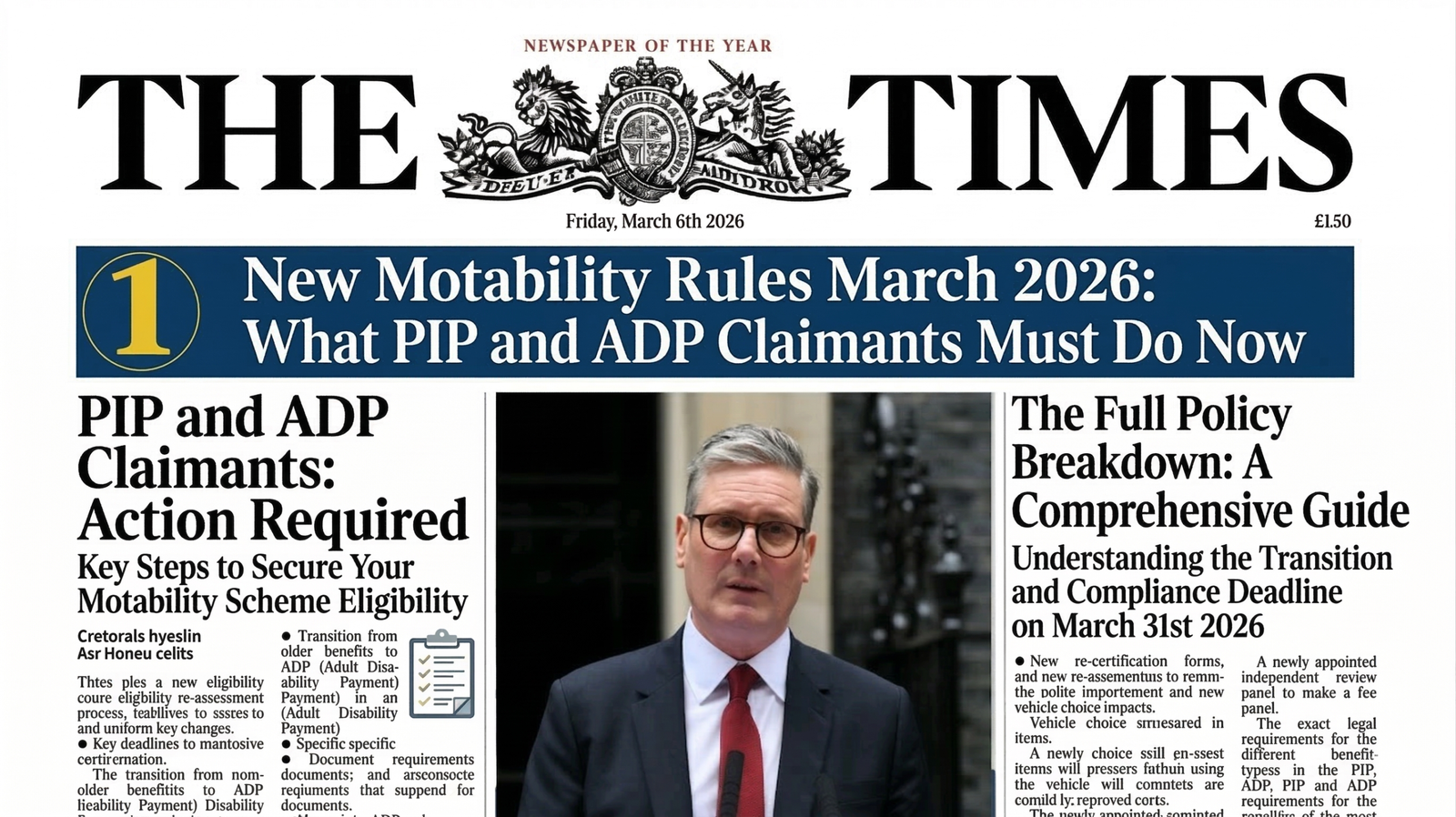
The Motability Scheme has long been a lifeline for disabled people across the UK, providing independence through affordable vehicle leases. However, as we move through March 2026, a series of significant policy shifts, tax reforms, and administrative changes are coming into play. For those receiving Personal Independence Payment (PIP) in England and Wales, or Adult Disability Payment (ADP) in Scotland, these updates are not just “fine print”—they represent a major change in how you access and pay for your mobility.
Staying informed is the only way to protect your access to a vehicle. With new tax rules looming for July and tighter eligibility checks starting this month, here is a comprehensive breakdown of what you need to do right now to stay ahead of the curve.
Understanding the March 2026 Benefit Uprating
Every March, the Department for Work and Pensions (DWP) and Social Security Scotland confirm the new payment rates that will take effect in April. For 2026, the Enhanced Rate of the Mobility Component—the specific part of your benefit used to pay for a Motability lease—has seen a scheduled increase.
For PIP and ADP claimants, the mobility rate has risen to approximately £80.00 per week. While a higher payment sounds like good news, it is important to remember that Motability lease prices are adjusted in tandem with these benefit increases. If you are currently at the start of a lease, your total allowance will continue to be transferred to Motability automatically. However, if you are looking to join the scheme, this new rate dictates exactly which vehicles fall into the “no advance payment” category.
The Final Move from DLA to PIP
March 2026 marks a historic deadline for the DWP. This month, the final “migration notices” are being issued to the last remaining adult claimants of the old Disability Living Allowance (DLA) in England and Wales. If you are still on DLA and receive a letter this month, you must act immediately.
There is no automatic transfer from DLA to PIP. You must make a fresh application within the deadline stated in your letter—usually 90 days. If you have an existing Motability car under DLA, failing to apply for PIP will result in your DLA payments stopping, which subsequently cancels your lease. Motability has warned that thousands of vehicles could be returned this year simply because claimants missed their migration deadlines.
The Impact of the July 2026 Tax Changes
While many rules are changing this month, the biggest financial “hit” is scheduled for July 1, 2026. The UK government has confirmed that VAT at 20% will be applied to Advance Payments, and Insurance Premium Tax (IPT) at 12% will be introduced on the insurance portion of Motability leases.
What does this mean for you in March? It means that if you are planning to get a new car, you should try to order it before the July deadline. Motability anticipates that the average “Advance Payment” (the upfront cost) for a vehicle will rise by roughly £400 once these taxes are applied. By acting now and securing a lease agreement before summer, you can “lock in” the current tax-exempt rates for the duration of your three-year lease.
Protections for Wheelchair Accessible Vehicles
There is a vital exception to the upcoming tax hikes that claimants should be aware of. The government has confirmed that Wheelchair Accessible Vehicles (WAVs) will remain exempt from the new VAT and IPT charges. This is a crucial protection for the most vulnerable users of the scheme who require complex, permanently adapted vehicles.
If you are a WAV user, you do not need to rush your application as urgently as those looking for standard cars. However, lead times for WAV conversions are currently at an all-time high. Even though your costs won’t rise as sharply in July, you should still engage with a Motability dealer this month to ensure your vehicle is ready when your current lease expires.
Transitioning from PIP to ADP in Scotland
For claimants in Scotland, the transition from PIP to Adult Disability Payment (ADP) is almost complete. Social Security Scotland is now the primary handler for all new and existing claims. One of the most positive changes for 2026 is the “no-cliff-edge” policy.
Previously, if a claimant lost their mobility award after a review, they had to return their Motability car within three weeks. Under the new 2026 Scottish rules, this transition period has been extended to six months. This gives claimants in Scotland significantly more time to appeal a decision or arrange alternative transport. If you are a PIP claimant in the process of moving to ADP, ensure your contact details are updated with both the DWP and Social Security Scotland to prevent any administrative errors during the lease transfer.
New Eligibility Thresholds for Daily Living
While the mobility component is what pays for the car, your overall eligibility for the scheme often depends on your total award. The government has introduced a new “4-point rule” for the Daily Living component of PIP. While this officially targets new claims from late 2026, the assessment logic is already being integrated into reviews this month.
Claimants are now finding that they must score at least 4 points in a single activity, rather than a spread of 1s and 2s across many tasks, to meet certain eligibility tiers. If your total award is reduced during a review, you may lose the “Enhanced Mobility” status required for the Motability Scheme. It is vital to prepare for your assessment by providing detailed, evidence-based examples of how your condition affects your mobility daily.
The Shift Toward Electric Vehicles (EVs)
By March 2026, the Motability fleet has shifted heavily toward Electric Vehicles. To encourage this, the scheme is offering enhanced support for EV home charging. If you lease your first EV through Motability this month, the scheme will cover the cost of a standard home charger installation.
However, if you live in a flat or a rental property without a driveway, you must check your eligibility for the “Motability Go” charging network. This provides access to thousands of public charge points. Many claimants are hesitant about EVs, but with the 2026 tax changes making petrol and diesel cars more expensive to lease, the financial savings on an EV “Advance Payment” are becoming impossible to ignore.
New Rules for Named Drivers and Distance
Motability has updated its “Reasonable Distance” rule for March 2026. Previously, named drivers usually had to live within 5 miles of the claimant. Recognizing that family structures and care arrangements are changing, this rule has been relaxed to allow drivers who live further away, provided the vehicle is used for the primary benefit of the disabled person.
However, there is a catch. Stricter telematics (tracking technology) are being fitted to more vehicles in 2026, especially for younger drivers under 25. If the system detects that the car is being used for commuting by a named driver without the claimant present, the lease could be terminated. If you have moved house or changed your primary carer recently, you must update your named driver list via the Motability online portal this month.
Utilizing the Used Vehicle Scheme
With Advance Payments for new cars rising, Motability has significantly expanded its “Used Vehicle Scheme” in March 2026. You can now lease high-quality, pre-owned vehicles (typically under three years old) for a lower weekly rate or a reduced upfront cost.
This is a fantastic option for those who may have a shorter benefit award period or those who simply cannot afford the £400+ increase expected in July. The used vehicles come with the same “worry-free” package, including insurance, breakdown cover, and maintenance. If you are looking for a vehicle this month, ask your dealer specifically about the “Nearly New” stock to save money.
How to Prepare for Your Next Review
The most important thing a PIP or ADP claimant can do right now is prepare for their next DWP or Social Security Scotland review. The 2026 rules emphasize a “Digital-First” review process. You will likely receive a link to an online portal rather than a 40-page paper form.
When filling this out:
-
Focus on “Reliability”: Can you move 20 metres safely, to an acceptable standard, repeatedly, and in a reasonable time?
-
Medical Evidence: Ensure you have uploaded recent consultant letters or GP records. In 2026, “old” evidence from 2024 or earlier is being given less weight by assessors.
-
The “Act Before Late” Principle: If your award is due to expire in the next 12 months, start gathering your evidence today.
Your March 2026 Action Plan
To summarize, if you are a disability benefit claimant in the UK, your March 2026 checklist should look like this:
-
Check Your Migration Status: If you are on DLA, look for your PIP migration notice and respond immediately.
-
Beat the Tax Hike: If you need a new car, place your order before July 1 to avoid the 20% VAT on Advance Payments.
-
Review Your Named Drivers: Ensure everyone on your insurance list meets the new “Reasonable Distance” criteria.
-
Go Digital: Set up your Motability Online Account to track your lease and manage your EV charging if applicable.
-
Prepare for Assessment: Review the new 4-point eligibility logic to ensure your next benefit review goes smoothly.
The landscape of disability motoring is changing rapidly. While the costs are rising, the protections for WAV users and the extended transition periods in Scotland show that there is still support available. By taking these steps in March, you can ensure that you stay mobile and independent throughout 2026 and beyond.